


Spread the word:


The 3 A’s of Tech Branding: Architecture That Scales
Part 1 of 3
Why do brilliant tech companies lose deals every day to competitors with inferior products?
Not because buyers are shallow. Not because they didn’t do their research. Not because your sales team failed.
Because when 47 cybersecurity companies all claim “next-gen threat detection,” your brand is the only thing that makes you recognizable before anyone reads your feature list.
Your product might be objectively superior. Your technology might be years ahead. But if your visual presence doesn’t communicate that superiority instantly, prospects will never get far enough to discover it.
A Roman architect named Vitruvius figured this out around 27 BCE. He wasn’t thinking about SaaS platforms or Series A pitch decks. He was thinking about buildings—specifically, what makes some structures endure for millennia while others crumble within years.

The Three Principles That Built Rome
Vitruvius identified three essential qualities that every lasting structure must possess:
Firmitas — Structural integrity. The foundation must be solid, the materials sound, the architecture built to withstand pressure and time.
Utilitas — Functionality. The structure must serve its purpose effectively. A theatre needs a stage. A fortress needs defensible walls.
Venustas — Beauty. The structure should inspire and create emotional resonance that makes people want to engage with what you’ve built.
Here’s what Vitruvius understood that most tech companies miss: you can’t choose two out of three.
A beautiful, functional building with poor structural integrity will collapse. A strong, beautiful building that doesn’t serve its purpose will sit empty. A strong, functional building with no aesthetic appeal will be demolished the moment something more inspiring comes along.
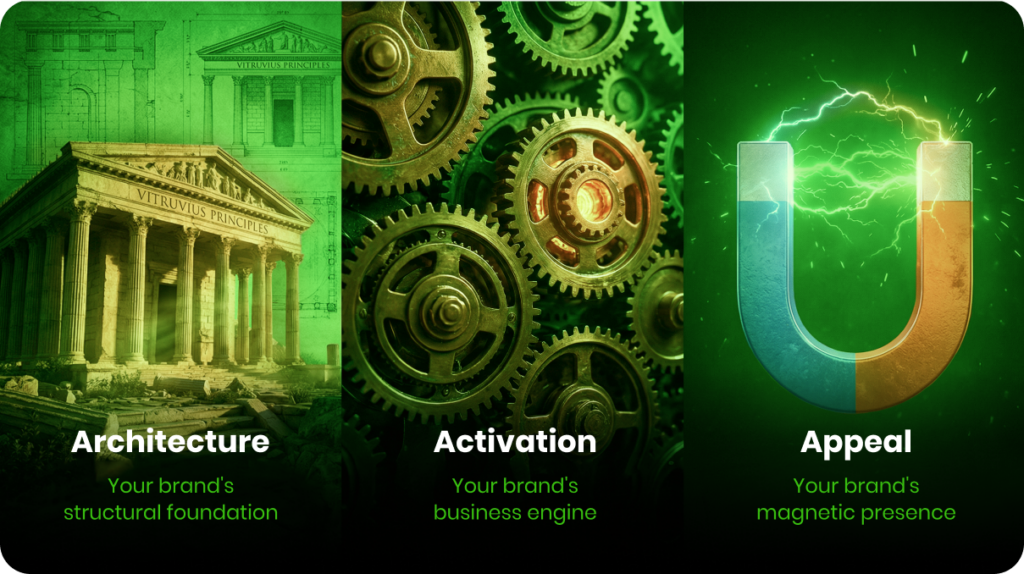
For tech companies, these principles translate to:
- Architecture — Your brand’s structural foundation
- Activation — Your brand’s business engine
- Appeal — Your brand’s magnetic presence
Most tech companies nail one of these, maybe two. The ones that command their categories have all three.
This is Part 1: Architecture. Let’s dig into the foundation most tech companies skip.
Architecture: The Foundation Most Tech Companies Skip
When you hear “brand architecture,” you might think of brand hierarchies or naming systems. That’s part of it. But the real meaning runs deeper.
Architecture is your brand as a systematic foundation—the rules, principles, and structure that let your visual identity scale without falling apart.
What Architecture Looks Like in Practice
Your pitch deck, website, sales collateral, conference booth, and product interface all feel like they came from the same company. Not because they look identical, but because they follow the same underlying system—consistent color usage, typography hierarchy, spacing rules, visual language.
When you hire a new designer or work with an agency, they can understand and apply your brand without asking you dozens of questions. Your brand guidelines aren’t a 200-page PDF nobody reads. They’re a clear system anyone can follow.
When you scale from one product to three, or from the US market to Europe, your brand doesn’t fragment into different visual languages. The architecture holds.
Think about Slack. You’d recognize their brand instantly—whether it’s a notification on your desktop, a billboard at a tech conference, or their enterprise security documentation. Same color system. Same typography. Same visual language. That’s architecture: a clear system that works everywhere, not just a collection of pretty designs.

What Architecture Looks Like When It’s Missing
Every presentation looks different because everyone’s making it up as they go. Your sales team uses off-brand templates because the “official” ones are impossible to work with. Your website was built by one agency, your pitch deck by another, and your product by your internal team—and it shows.
You can’t articulate your brand guidelines without saying “it depends” or “use your judgment.” New designers spend weeks trying to reverse-engineer your brand system from existing assets because there isn’t a real system to begin with.
Compare that to the typical B2B tech company whose “brand” is whatever the founder’s nephew threw together in Canva. No consistency. No system. Just chaos pretending to be professional.

The Architecture Audit
Ask yourself these questions:
Could someone else use your brand system without asking you questions?
If a designer can’t apply your brand confidently without constant clarification, you don’t have a system.
Does your pitch deck follow the same visual rules as your website and sales materials?
If different touch points feel like different companies, your architecture is fractured.
When you scale to a new product or market, does your brand hold together or fragment?
If every expansion requires a “rebrand,” you never had architecture to begin with.
If you answered no to any of these, you don’t have architecture. You have improvisation pretending to be a brand.
If you answered no to any of these, you don’t have architecture.
You have improvisation pretending to be a brand.
Why Architecture Alone Isn’t Enough
You can have the most technically perfect brand system in the world. Every pixel precisely placed. Every color mathematically balanced. Every guideline documented.
But if nobody remembers you and your brand doesn’t drive business outcomes, you’ve just built an impressive structure that nobody cares about.
Architecture is the foundation. But a foundation alone doesn’t make a building people want to enter.
That’s where the second principle comes in: Activation—your brand as a business engine that drives measurable results, not just aesthetic satisfaction.
Continue to Part 2: The Business Engine Most Agencies Ignore
This is Part 1 of our 3-part series on the Vitruvian principles of tech branding:
- Part 1: Architecture That Scales (you are here)
- Part 2: Activation That Converts
- Part 3: Appeal That Captivates